
‘Discrimination related to poverty’ LISI Livret de Formation 2026
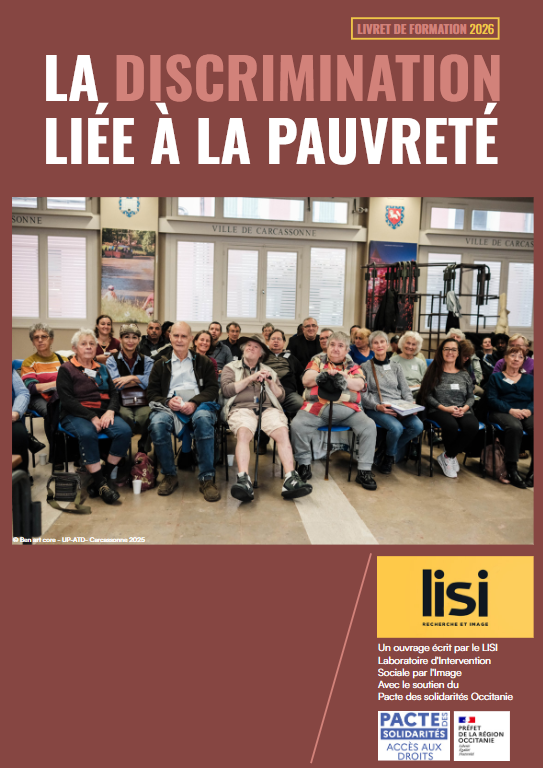
In February, a French publication was released on socio- economic discrimination or ‘discrimination related to poverty’ by LISI (Laboratoire d’Intervention
Sociale par l’Image/ Labratory for Social Intervention through Images) in collaboration with ATD Fourth World and other organisations.
In France, ATD managed to “Add the 21st” ground of discrimination in 2016. The 21st ground is called “PVE (Particulière Vulnérabilité Economique)” or Particular Economic Vulnerability or ‘Discrimination 21’.
At ATD Ireland we will be hoping and asking that the upcoming EU anti poverty strategy (to be launched on May 6th by the European Commission) will commit to ending socio- economic discrimination for families and individuals living in poverty across Europe, and that the upcoming Irish Presidency of the Council of the EU will prioritise the voice of people living in poverty and the implementation of the anti poverty strategy in the EU. At ATD Ireland we continue to advocate to #Addthe10th ground of socio- economic status in Irish Equality Legislation.
Summary
DISCRIMINATION BASED ON POVERTY
(LA DISCRIMINATION LIÉE À LA PAUVRETÉ)
By the LISI, the Laboratory for Social Intervention through Images (le Laboratoire d’Intervention Sociale par l’Image)
FOREWORD (Édito)
They explain that this booklet is born from the observation that despite the fact that poverty is everywhere, it’s less and less cared about and still a blind spot in policies fighting against discriminations. They hope to encourage people to question their own approaches to welcoming and supporting. It’s filled with testimonies of people from diverse backgrounds, around several important issues (housing, health, rights, etc.)
SOCIOLOGY (Sociologie)
The chapter analyses poverty as a structural inequality that might lead to specific discriminations. It distinguishes poverty and precariousness, their social mechanisms and their discriminatory effects. It highlights the limitations of the legal recognition of the PVE* (*the French equivalent of socio-economic discrimination, poverty-related discrimination) and what affects its efficiency. They also give a reminder that this recognition/breakthrough was possible thanks to on-the-ground efforts.
- Understanding poverty to understand PVE (Comprendre la pauvreté pour comprendre la PVE)
They argue that the notion of poverty is blurry, never precisely defined by law, which lead to misunderstandings, lack of recognition, struggles in the fight against it; it’s thus essential to understand poverty, whom it affects, its patterns, and its representations to think and fight poverty in a clear and efficient way.
PVE is not just an economic situation, but a complex social position exposed to stigmatisation, exclusion and differences in how they’re treated. They define a double dimension to take into account when talking about PVE: an objective one (social housing for example) and a subjective one (a name, an appearance, etc.) Poverty is said to be defined by society through standards of care, which label poor people with a specific social status, often stigmatising.
They explain how the average of people living below the income poverty line in 2023 in France (15,4% of the population) is actually marked by great disparities between social groups (unemployed people, students, single-parent families, disabled people, etc.)
- Understanding poverty: general frame (Comprendre la discrimination : cadre général)
They remind that social inequalities and discriminations are not the same thing. They distinguish 3 types of discriminations (direct, indirect and systemic) and how they’re reinforced by cognitive mechanisms (stereotypes, social categorising), which can lead to unconscious discriminatory behaviours. People can also combine discriminations: that’s intersectionnality.
In France, a lot of factors contributed to the evolution of public policies against discriminations: collective mobilisations, social or sanitary crises, international conferences, academix research and on-the-ground actors.
But it’s really the combination of feminist, antiracist, and LGBTQ+ mobilisations and european directives that progressively imposed the notion of discrimination; although these evolutions put aside the systemic mechanisms engraved in the institutions.
They also mention the massive underutilisation of rights, and how discriminated against people are often scared to file a complaint, revealing a kind of trivialisation of discriminatory behaviours in public services, schools, the police or in the job field.
The fight against discriminations can’t be distinguished from this against social inequalities.
- Late recognition of PVE: an on-the-ground fight (Reconnaissance tardive de la PVE : une lutte issue du terrain)
ATD Fourth World was the first to express and act for the need to change and to recognise PVE as a legal discrimination in 2009, by collecting and sharing testimonies and documentation on the subject.
The report suggests different actions to improve the law efficiency, among which clarifying what PVE actually juridically means, training professionals to identify PVE and giving visibility to the matter in public policies.
This is done in a logic of democratisation of the access to rights, where juridical recognition is not sufficient.
TESTIMONIES (Témoignages)
The testimonies delivered in this booklet show that experiences of discrimination are varied, as are the ways to face them; but being in situation of economic vulnerability is a common factor.
- ATD Quart Monde
Paulette’s, Rose’s and Marie-Claire’s (ATD activists) testimonies explain how they have suffered and still suffer from discriminations, and how ATD gave them a way to express themselves without being put in an inferior position.
Christelle (care assistant, activist of ATD) talks about an uncertain and sometimes restricted access to rights, and how ATD helped her transform what she lived into something she can testify about and teach from.
p.19
Paulette raconte son rapport à la lecture et à l’écriture, appris avec effort, dans ce monde où tout passe par l’écrit.
« Moi je lis mais tout doucement. Et j’écris comme j’entends. […] Il y a une discrimination sur ça aussi. Ça aussi, il faut en tenir compte, on n’a pas fait de grandes études. »
Paulette décrit des situations observées à l’école, dans lesquelles les enfants issus de familles en grande pauvreté sont plus rapidement considérés comme problématiques, orientés vers des dispositifs spécialisés, médicalisés ou judiciarisés.
« Un enfant riche, on va convoquer les parents. Un enfant pauvre, on va chercher le problème chez lui, chez sa famille. Ce n’est pas normal. »
La pauvreté agit ici comme un marqueur social, qui transforme des difficultés ordinaires en suspicions de défaillance parentale.
_______________________________________________________________________
Their [Paulette, Rosette and Marie Claire] participation [in ATD Fourth World] is part of a wider approach of co-creation, where lived experiences become a field of knowledge in its own right, questioning professional practices, institutions and public policies.
“Poverty has several faces. We can’t say that poverty is only equal to homelessness. Poverty is survival above all.”
Paulette tells us her relation to reading and writing and, which she learned through hard work in a world where everything comes down to written words.
“I read, but I read slowly. And I write like the sounds I hear. […] We can be discriminated against because of this too. This, too, must be taken into account; we never did great studies.”
Paulette describes some situations she noticed at school, where children from families living in great poverty are more quickly labelled as ‘problematic’, referred to specialist, medical or legal services.
‘If a child is rich, we call their parents in. If a kid is poor, we look for a problem at home, in their families. This is not normal.”
Poverty is here equal to a social marker, that turns ordinary difficulties into suspicions of parental failure.
P.20
Les guichets, les assistantes sociales, les services publics deviennent parfois des lieux où se rejoue l’injustice. La pauvreté n’est plus seulement un manque d’argent ; elle s’accompagne d’un soupçon, d’un regard qui juge avant même d’écouter.
Les récits de Paulette et de Rosette montrent que l’entrée dans ATD n’a rien d’évident. Elle passe souvent par la méfiance, la peur des institutions, la crainte d’être jugée ou contrôlée. Progressivement, ces rendez-vous deviennent un rituel, un espace sécurisé, puis un point d’appui pour s’engager davantage. « C’est ATD qui m’a appris à lire. Quand je me suis mariée, j’ai un peu abandonné. Et puis après, quand j’ai eu les petits, j’ai rencontré Jacques, c’était un allié dans ATD. »
« Et voilà, je suis là, militante depuis 2017 […] ATD, c’est mon remède. »
Participer n’a de sens que si cela permet de com prendre, de contribuer, et surtout de pouvoir agir ensuite pour aider d’autres familles.
________________________________________________________________________________________________
Service desks, social workers and public services sometimes become a source of injustice repetition. Poverty is not only about financial struggle; it is accompanied by suspicions, by a gaze that passes judgment before even taking the time to listen.
Paulette’s and Rosette’s stories show that joining ATD is far from simple. There’s often distrust, the fear of institutions, the fear of being judged or controlled.
These meetings slowly began a ritual, a safe space, a foothold to get more involved. “It’s ATD that taught me how to read. When I got married, I gave up on it a little. And then, when I had my kids, I met Jacques, he was an ATD ally.” “And here I am, activist since 2017 […] ATD is my remedy.”
À travers les récits de Paulette, Rosette et Marie-Claire, ATD Quart Monde apparaît comme un espace où la pauvreté cesse d’être une honte individuelle pour devenir une question politique et collective. La discrimination liée à la pauvreté n’est pas un accident : elle est produite par des pratiques ordinaires, des dispositifs mal pensés et des représentations sociales persistantes.
La parole n’est pas seulement un outil de lutte contre la pauvreté : elle en est la condition. « On apprend à parler, à comprendre, à ne plus avoir peur. Et quand on comprend, on peut agir. » Paulette.
____________________________________________________________________________________________
Through Paulette’s, Rosette’s and Marie-Claire’s stories, ATD Fourth World appears as a space where poverty is not considered as an individual shame anymore, and becomes a political and collective issue. Socio-economic discrimination is no accident: it is created by ordinary practices, ill-conceived systems and social persistent representations.
A voice is more than just a tool to fight poverty: it is its prerequisite. “We learn to speak, to understand, and to let go of our fear. And when we understand, we can act.” Paulette
Quand l’accès aux droits devient incertain
L’un des épisodes marquants de son récit concerne une situation administrative en apparence banale : le retard de versement d’une bourse scolaire pour sa fille, malade, scolarisée à distance. « La secrétaire du rectorat m’a dit avec nonchalance : “Votre dossier n’a pas été traité, on est en sous-effectif.” » Ce qui frappe Christelle, ce n’est pas seulement le retard, mais l’absence totale de solution. Aucun recours proposé, aucun interlocuteur identifié, aucun délai annoncé. « Je me suis dit : je suis tombée sur une zone de non-droit. »
Elle décrit ces espaces institutionnels où les règles semblent suspendues, où les droits existent en théorie mais deviennent inaccessibles en pratique. Grâce à son engagement à ATD Quart Monde, Christelle mobilise un contact du Défenseur des droits. Deux semaines plus tard, la situation est débloquée.
Son analyse est sans concession : l’accès effectif aux droits dépend souvent moins des dispositifs que de la capacité à connaître les bons relais.
Renoncer à ses droits ne relève alors plus d’un choix, mais d’un épuisement.
___________________________________________________________________________________
When the access to rights becomes uncertain
One of the memorable moment of Christelle’s story is related to a seemingly trivial administrative situation: the delay in the payment of a scholarship for her daughter, who is sick and studying remotely. “The school office secretary told me nonchalantly: ‘Your application has not been treated; we are short-staffed.’” What strikes Christelle is not only the delay, but the complete lack of solution. No remedy is suggested, no contact person is identified, no deadline is announced. “I thought to myself: I’ve fallen in a non-right area.”
She describes these institutional spaces as spaces where rules seem to be suspended, where rights exist theoretically but are practically inaccessible. Thanks to her involvement with ATD Fourth World, Christelle calls upon an Ombudsman. The situation is resolved two weeks later.
Her analysis is uncompromising: effective access to rights depends less on the systems in place than on the ability to identify the right persons to contact.
Renouncing to your rights is not a choice anymore, but an exhaustion.
P.27
ATD Quart Monde : transformer le vécu en savoir
La rencontre avec ATD Quart Monde marque un tournant dans le parcours de Christelle. Elle y découvre un espace où son expérience n’est ni minimisée ni disqualifiée, mais reconnue comme un savoir. « C’est un système révolutionnaire : on échange sur un pied d’égalité avec ceux qui d’habitude sont au-dessus de nous. »
Il ne s’agit pas seulement de mieux s’exprimer, mais de se reconnaître comme sujet politique, capable d’interroger l’ordre institutionnel. ATD Quart Monde appelle cela le pouvoir d’agir : une compétence collective qui se construit dans le temps, à plusieurs.
____________________________________________________________________________________
ATD Fourth World: turning lived experience in knowledge
Her meeting with ATD Fourth World has been a turning point in Christelle’s life. There, she discovered a space where her experience was neither minimised nor invalidated, but recognised as a source of knowledge. “It’s a revolutionary system: we discuss on an equal footing with those who are usually above us.”
More than improving how you express yourself, it is also a matter of recognising yourself as a political agent, able to question the institutional order. This is what ATD Fourth World call the power to act: a collective competence that is built up together over time.
P. 28
[É]couter la pauvreté ne relève pas de l’empathie individuelle, mais d’une compétence collective à construire.
Chaque formation, chaque échange, chaque prise de parole compte.
_________________________________________________________________________
Listening to poverty does not stem from personal empathy, but from a shared competence to be built up.
Every training, every exchange, every statement matters.
